A young man waits by the hydrotherapy pool with his mother. I don’t know his story – but it’s evident he lives with some significant physical challenges. Suddenly his physiotherapist walks into the pool area and the young man’s face lights up. He doesn’t speak, but his face and actions say it all. He shuffles with delight towards her. For the next hour in the pool, their deep, caring connection is clear to see.
As I watched the young man’s response to his health worker, my mind went back to when Arli was a toddler and didn’t speak. I would arrive home from work, and he would run to me with a big smile on his face. He would often fall, but he was quickly back on his feet. He couldn’t use words at the time, but his sounds and actions demonstrated the power of presence and connection.
Part of my post-surgery recovery includes a daily visit to a local hydrotherapy pool. Each day, there’s a diverse group of people in the water. Some familiar faces. Some new. And yet we all have some things in common – we all reflect human frailty – and we all innately yearn for connection.
Like an older, widowed man, Terry, who I was chatting to in the pool this week. Terry has knee and back issues. He told me he looked forward to his three visits to the pool each week. “I don’t know much it helps my old body, but I love getting out of the house, being around others and having a chat”.
I’ve been referring to the warm water and spa area at Box Hill Aqualink as the “pool of Bethesda”. That’s the name of a large pool referred to in John’s Gospel. This ancient pool was surrounded by covered colonnades and we read that many people, including “the blind, the lame, the paralysed”, lay by the pool. It seems many people were left there to fend for themselves given the pool’s superstitious healing qualities. It was an arena of desperation. And so many – across our local communities, country and world – live in such an arena in 2025 – isolated and bereft of hope.
The John 5 story is at odds with what I witnessed at the pool today. The young man had his mother by his side and his physio is clearly a highly valued presence in his life. Amid his physical challenges he has others in his corner. Whatever our situation, the caring presence of others is life changing. I know my physical recuperation is aided by knowing I have many in my corner, cheering me on.
In the gospel narrative we’re told of a man who has been paralysed for more than 40 years. Beyond the man’s physical challenges, he yearns for genuine care and connection.
Like many western countries, Australia is marked by a growing social isolation and loneliness crisis. It’s a silent epidemic that rarely gets media attention. It impacts across the age and culture spectrum. It includes older people living alone, younger people living with mental health challenges, stretched single parents and refugees and asylum seekers. Friend and prominent social justice advocate Tim Costello has rightly highlighted that social isolation is a significant public health hazard, linked to physical and mental health issues, poverty and other social challenges. [I’ve placed a few links at the end of the post if you want to read about this issue in more detail.]
As I was doing my walking laps in the pool today, and reflecting on my chat with Terry, I was challenged to ask myself two simple, important questions:
- Who do I know today that is socially isolated or struggling with loneliness or displacement?
- And what can I practically do to support this person, or help them access more supports in their life?
In the John 5 story, suddenly everything changes when Jesus enters the arena of desperation. Full of compassion, with his eyes and ears open, Jesus sees the paralysed man. I love that phrase in the passage … “Jesus saw the man”. He saw him! Not just another in the crowd, not just a public health statistic. Jesus saw an individual, with a personal story, unique needs and a yearning for connection and care. Jesus engages in the man’s world. Suddenly the man by the pool is not alone!
I was in Canberra recently with other Baptist leaders meeting with Federal MPs and Senators. We were advocating for the needs of displaced people in Myanmar and neighbouring border regions. These are some of the most vulnerable people on the planet. And yet our Australian media gives so little attention to the growing humanitarian crisis in Myanmar, particularly since the cessation of USAID funding.
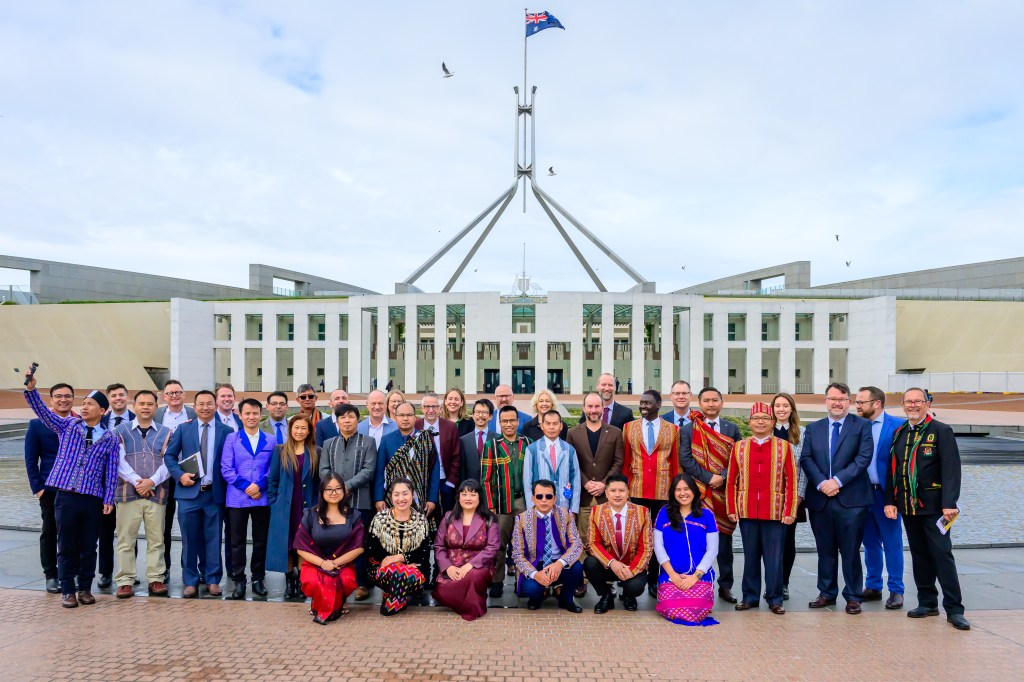
Standing alongside me in my Canberra meetings were members of the Burmese diaspora in Australia – people with lived experience of the horrors of fleeing conflict, violence and human rights abuses in their home country. And people desperate to support displaced loves ones still in Myanmar.
As we walked from a meeting one of the Burmese leaders teared up. He said: “Scott, I hope these meetings will in some way make a difference for my people, but I know I am going home to my family and Chin church to remind them that we are definitely not alone. We are not forgotten!”.
We gave each other a hug. We embraced the power of presence and connection.
In a world that at times can seem overwhelming, we have all something incredibly special to offer others. We can offer ourselves! We can make ourselves available. We can come alongside others – family, friends, neighbours and strangers and offer them the beautiful gift of presence and connection. And we can cherish and never take it for granted when we have others in our corner.
https://www.aihw.gov.au/mental-health/topic-areas/health-wellbeing/social-isolation-and-loneliness
 apilgrimpens