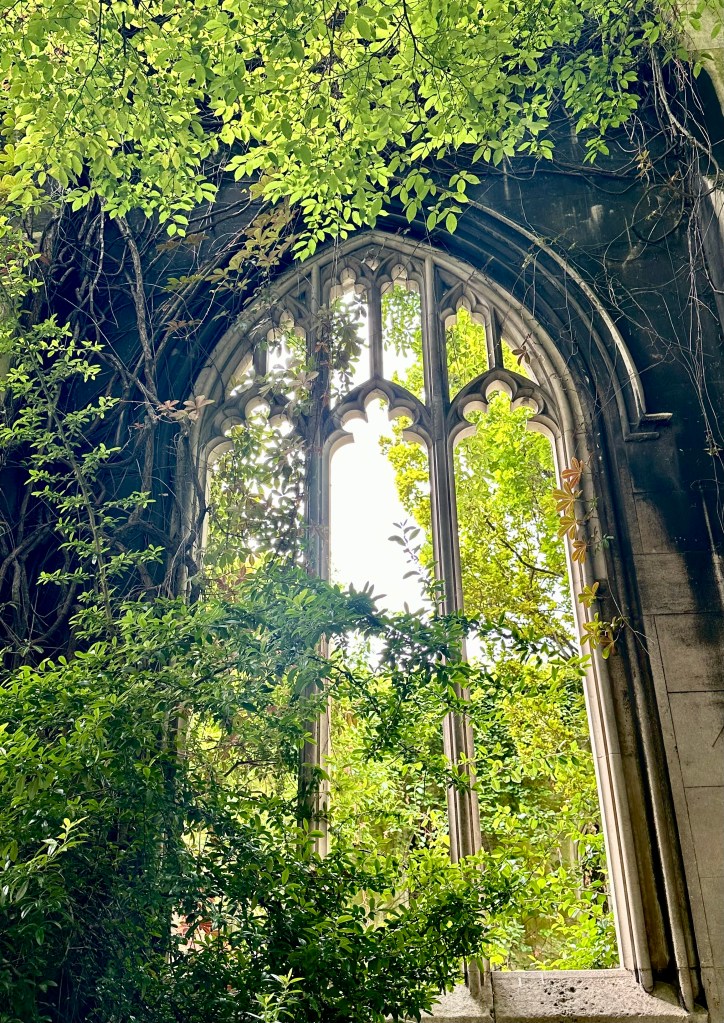
St Dunstan in the East church garden is a hidden London gem. I’m so glad I made a visit last week. And beyond its beauty and peacefulness, I will remember the garden as the place I got to road test the emergency call function on my watch.
Yes, while taking photos and breathing in this special, sacred place I had a hard fall, thankfully on to grass. Suddenly my watch was beeping and I was being asked my condition. I’ve no clue how this function works, but it was quick to respond to my wobbly moment. Sore and a tad embarrassed, I got back up and took in more of this historic, life-giving space.
The St Dunstan church was originally built around 1100. It was severely damaged in the Great Fire of London in 1666. The church was repaired and patched many times in the the centuries that followed, before being severely damaged in the 1941 London blitz. In 1971, the City of London opened a public garden, established around the church sanctuary ruins.
As I sat on a timber bench, under the cover of gorgeous green, and rubbing my hands on ancient church walls, I was struck by the symbolism of this special place.
In the midst of a large and busy city, here is a place of stillness. Here is a place to rest amid the hectic pace of life. Surrounded by tall buildings and London traffic, here is a small green oasis: a place to catch your breath and allow both nature and quietness to fuel the soul.
The older I get, the more I know I need rhythms of slowness, rest, stillness and quiet. More time in park benches, more time under trees. And yet I still haven’t mastered the art of slowing. I can be too quick to leave all that the St Dunstan garden represents for the busyness of life, which strikes you as soon as you step back on Lower Thames Street, near London Bridge.
Way back in 1991, in my first year at theological college, I read the late Calvin Miller’s “The Table of Inwardness”. In the beautiful little book Miller speaks of busyness as a lion of our culture, seeking to devour us. More than thirty years on, I still fight with that lion all too regularly.
Miller also painted the picture of what it looks like to sit with Jesus at a table for two, cultivating deeper and richer relationship and with the Good Shepherd. So much more than when Miller wrote, our culture today seduces us with the call of immediacy, which can lead us to a shallow, drive-through spirituality.
In big cities across the world I have discovered hidden small green spaces, which stand as a counter-cultural places amid busyness and consumerism. I’m writing this post from a park bench looking over a small lake in Stavanger in Norway. I have nowhere I need to be in a hurry. So it’s good to linger. And yet I still have to resist the the pull to leave and pursue other activities.
I hope as you take a little time to look at the photos from the St Dunstan garden you will have the opportunity to ponder your own rhythms. You may have this mastered – and if so, good on you. But if you’re like me, this is a constant work in progress.
Jesus would have been right at home retreating in the St Dunstan garden, before advancing in the pursuit of shalom. He knew the importance of lingering longer. That’s my challenge. My need. To linger longer. To grow more and more in the practice of cultural resistance – to be still, to slow, to be quiet, to rest, to sit under trees, rub ancient walls and allow the Spirit of God space to do his beautiful soul-renewing work.
I’m thankful for my visit to the St Dunstan garden. It surprised me by its beauty. And I should know better by now, but as I slow and catch my breath, I open myself up to simple grace surprises all around me!
 apilgrimpens